2 days ago
5 days ago
1 week ago
1 week ago
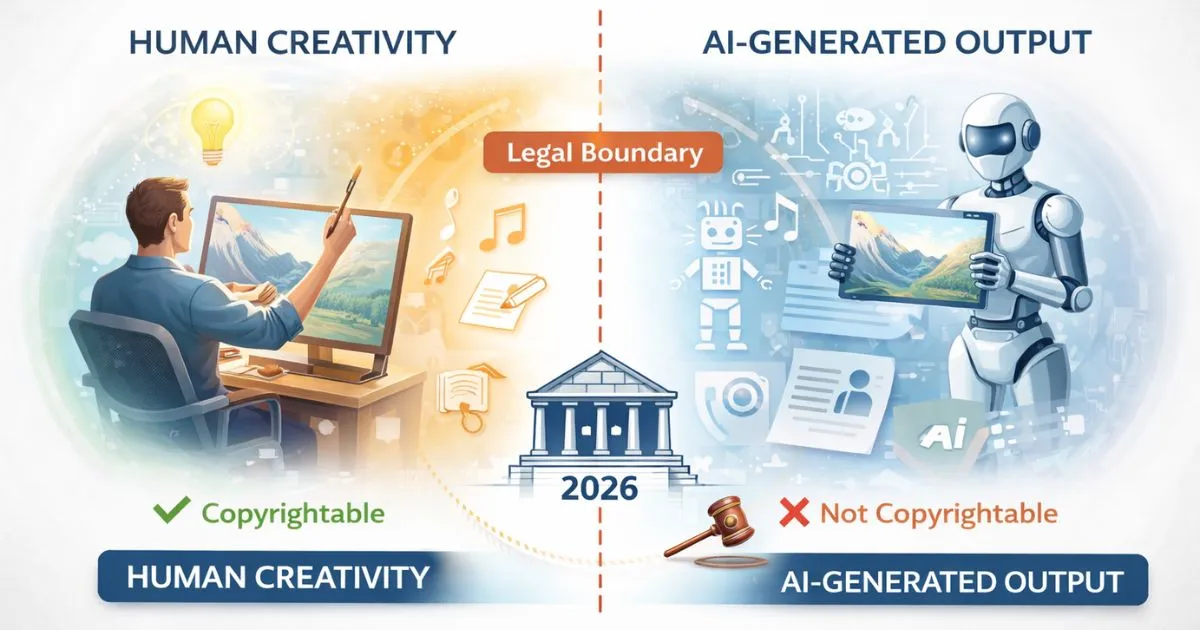
On March 2, 2026, the legal saga that defined the boundaries of modern creativity reached its final conclusion. The U.S. Supreme Court denied certiorari in Thaler v. Perlmutter, officially closing the door on the attempt to recognize an Artificial Intelligence system as a legal "author" under current United States law.
The Case Highlights:
Plaintiff: Dr. Stephen Thaler, who sought to copyright an AI-generated artwork titled "A Recent Entrance to Paradise."
The Claim: Thaler argued his AI system, the "Creativity Machine," should be listed as the author, with him as the owner.
The Final Verdict: The Supreme Court declined to hear the appeal, leaving intact the D.C. Circuit Court's ruling that human authorship is a bedrock requirement for copyright protection.
The 2026 legal consensus rests on several statutory interpretations:
Lifespan Provisions: Copyright duration is tied to the "life of the author plus 70 years." Machines do not have a biological lifespan, making this provision nonsensical for AI.
Property Ownership: Under the Copyright Act, an author must have the legal capacity to own property and enter contracts—capacities that AI systems currently lack.
Incentive Theory: The court ruled that copyright is intended to incentivize human intellectual labor. Since AI does not respond to economic incentives, extending authorship to it does not serve the law's constitutional purpose.
It is crucial to note that this verdict does not ban all AI-related copyrights.
Autonomous AI (Denied): Works created solely by AI without human input (like Thaler's) are not copyrightable.
AI-Assisted (Allowed): If a human uses AI as a tool (similar to a camera or a brush) and provides "significant creative contribution," the work can still be copyrighted—but the human must be listed as the author.
This ruling solidifies the U.S. position alongside Germany and other major jurisdictions, treating AI as a tool rather than a peer. While Dr. Thaler’s attorneys warn of a "chilling effect" on innovation, the ruling provides much-needed clarity for studios, tech companies, and independent artists regarding the ownership of their digital assets.
Legal analysis based on the U.S. Supreme Court Docket No. 25-449, D.C. Circuit Opinion (130 F. 4th 1039), and U.S. Copyright Office Registration Guidance 2026. https://www.copyright.gov/
1 hour ago
2 hours ago
13 hours ago