2 days ago
5 days ago
1 week ago
1 week ago
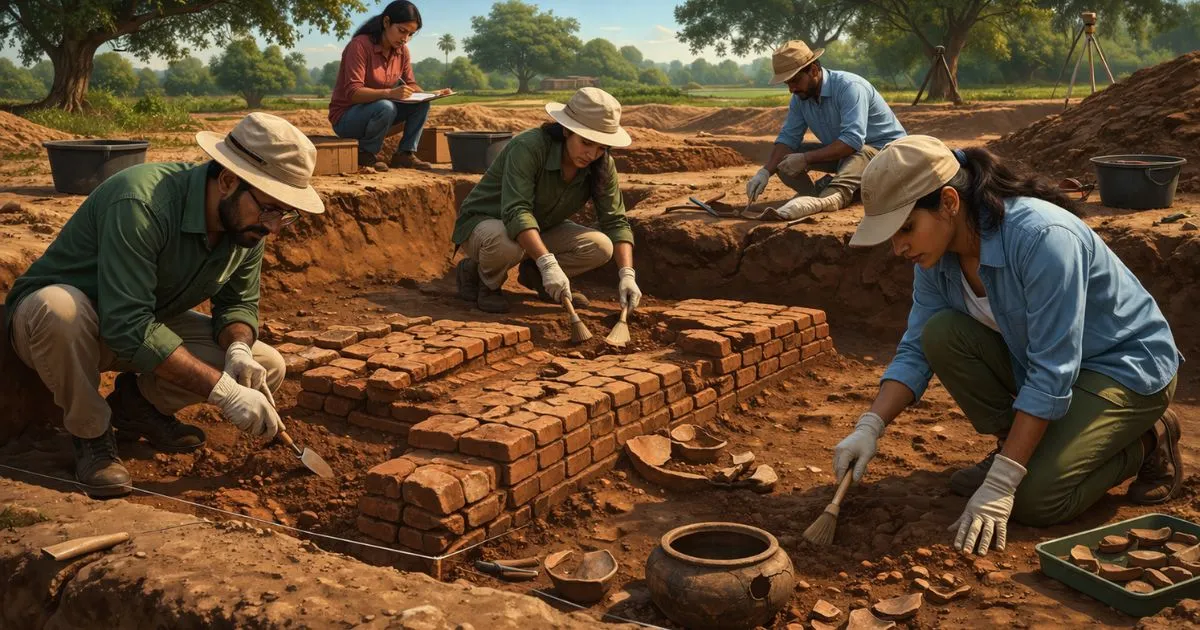
In the heart of Bihar’s Madhubani district, the massive ramparts of Balirajgarh are finally surrendering their oldest secrets. As of March 2026, the Archaeological Survey of India (ASI) has reached the stratigraphical "sweet spot"—the Iron Age layers that suggest this fortified city was a major power center long before the rise of the Mauryan Empire.
Spread over nearly 175 acres, Balirajgarh has long been associated in local folklore with the legendary King Bali. However, the current 2026 excavation season is providing a more grounded, yet equally fascinating, historical narrative.
The most striking feature of Balirajgarh is its enormous fortification wall.
The Scale: The walls are nearly 5 meters thick and were originally constructed of mud, later reinforced with burnt bricks during the Shunga period.
The 2026 Discovery: Archeologists have found evidence of an even earlier wooden palisade system beneath the mud ramparts, typical of Iron Age defensive structures found in the Ganges basin.
The presence of Northern Black Polished Ware (NBPW) in high concentrations confirms that Balirajgarh was an elite urban center.
The Finds: Beyond pottery, the 2026 dig has unearthed terracotta figurines, semi-precious stone beads, and iron implements including spearheads and nails.
Economic Links: The variety of beads suggests that this "Iron Age Kingdom" was a hub in a trade network connecting the Himalayan foothills to the Magadh heartland.
The excavation reveals a continuous occupation that spans several centuries.
| Period | Estimated Dates | Key Findings at Balirajgarh |
| Iron Age | 1000 BCE – 600 BCE | Early fortifications, grey ware, iron tools |
| NBPW Phase | 600 BCE – 200 BCE | Elite pottery, punch-marked coins, urban planning |
| Shunga/Kushan | 200 BCE – 300 CE | Burnt brick structures, elaborate terracotta art |
"Balirajgarh isn't just a site; it’s a library of the Mithila region's evolution. By reaching the Iron Age levels, we are essentially reading the preface of urban civilization in North Bihar." — Lead Excavator, ASI 2026 Session.
These findings are crucial for understanding the Videha (Mithila) Kingdom, one of the prominent Janapadas mentioned in ancient texts. Balirajgarh provides the physical evidence of the sophisticated engineering and social hierarchy that governed this region nearly 3,000 years ago.
Source / Resource: Updates synthesized from ASI Patna Circle Field Reports (March 2026) and the Bihar State Archaeology Directorate.
1 hour ago
13 hours ago
1 day ago