2 days ago
5 days ago
1 week ago
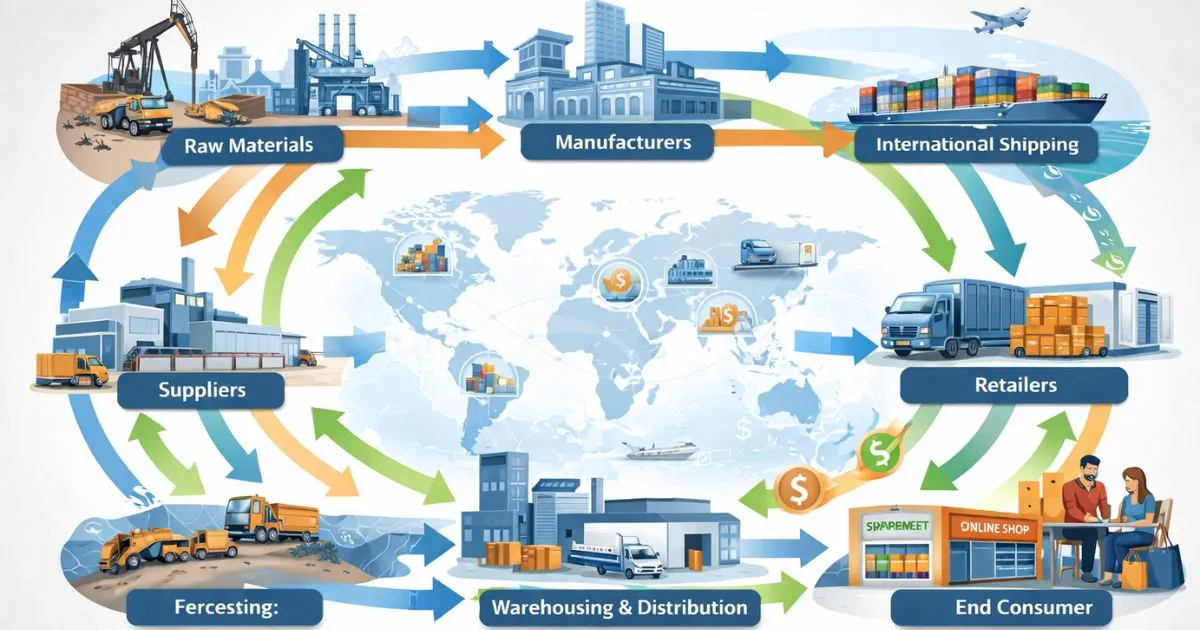
In 2026, international trade is no longer just about moving boxes across oceans; it is a sophisticated dance of data, diplomacy, and lightning-fast logistics. At its simplest, international trade is the exchange of goods and services across borders. But behind every "Made in..." label lies a massive, invisible network known as the Global Supply Chain.
Why doesn't every country just make everything themselves? The answer is Comparative Advantage.
The Concept: A country produces what it can make most efficiently and at a lower opportunity cost than others.
Example: Brazil exports coffee because its climate is perfect for it, while Taiwan exports semiconductors because of its advanced tech infrastructure. By trading, both countries end up with more of both products.
A global supply chain is a series of steps required to get a product from the raw material stage to the customer.
Sourcing: Raw materials (like lithium from Chile) are extracted.
Manufacturing: Components are made in one country (batteries in China) and assembled in another (EVs in Germany).
Distribution: Finished goods move via "Multimodal Transport" (ships, trains, and trucks).
Last Mile: The product reaches your doorstep via local delivery.
For decades, the goal was Just-in-Time (JIT)—keeping zero inventory to save money. However, after the disruptions of the early 2020s, 2026 has seen a shift toward Just-in-Case (JIC).
Resilience: Companies now keep "buffer stocks" and use Near-shoring (moving factories closer to home) to avoid delays caused by geopolitical tensions or climate events.
Trade isn't always free. Governments use tools to protect local industries:
Tariffs: Taxes on imported goods.
Quotas: Limits on the quantity of a good that can be imported.
Trade Blocs: Groups like the EU or USMCA that lower barriers between members to boost regional growth.
In 2026, supply chains are "smart." Digital Twins (virtual copies of the supply chain) allow companies to predict a port strike or a hurricane before it happens, rerouting ships in real-time using AI.
Trade data and logistics trends based on the WTO World Trade Report 2026 and UNCTAD Review of Maritime Transport. https://www.wto.org/
1 hour ago
2 hours ago
13 hours ago